
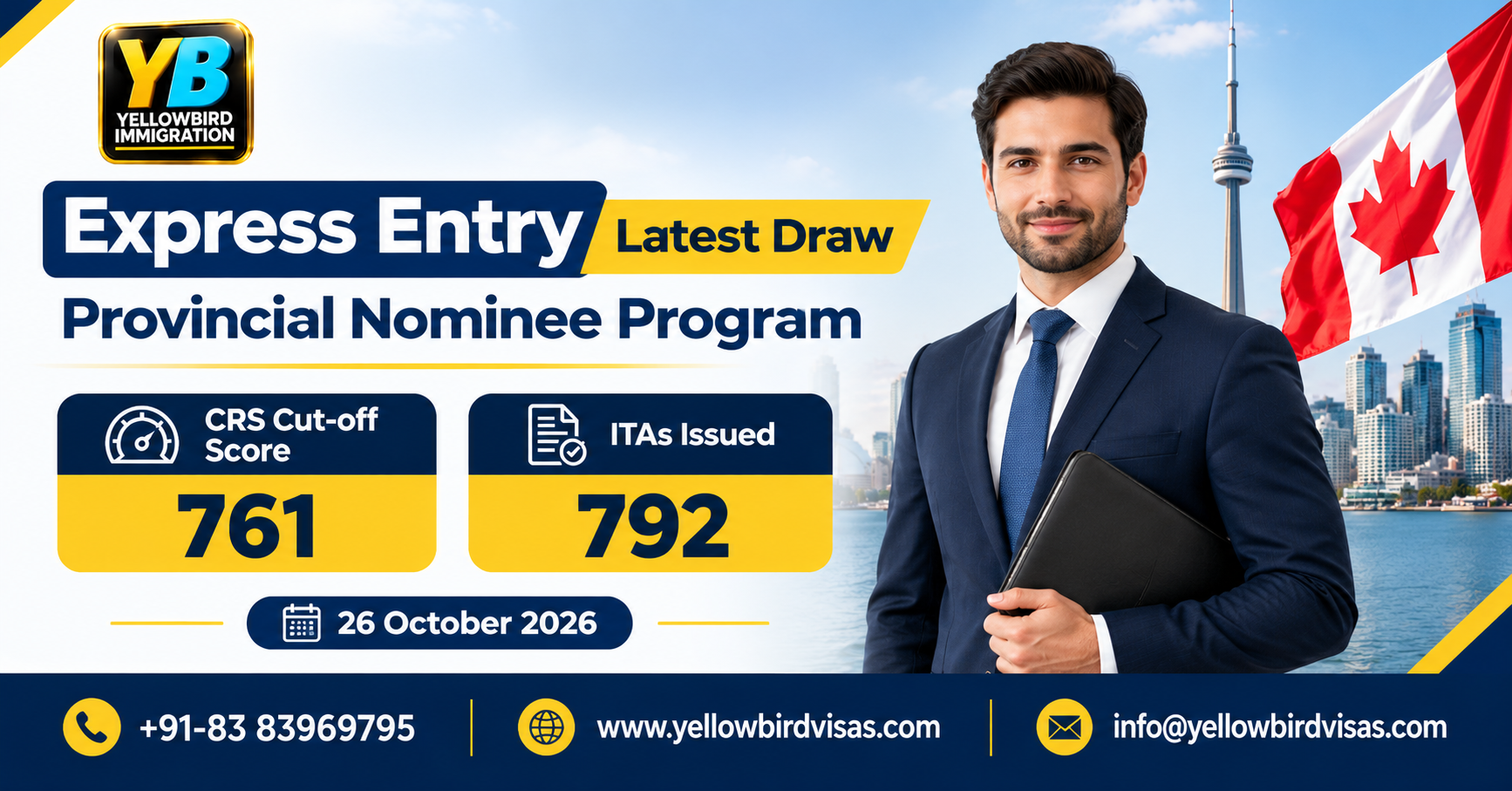
Canada continues to offer opportunities for skilled workers who want to build a long-term future in the country. On October 26, 2026, Immigration, Refugees and Citizenship Canada (IRCC) issued 792 Invitations to Apply (ITAs) for permanent residence through an Express Entry draw dedicated to Provincial Nominee Program (PNP) candidates. The minimum Comprehensive Ranking System (CRS) score required in this round was 761. Candidates also needed to have submitted their Express Entry profiles before the specified tie-breaking deadline.
This latest selection round highlights the importance of provincial nominations for skilled professionals who want to settle in Canada. For eligible candidates, a provincial nomination can significantly improve their Express Entry ranking and create a stronger pathway towards permanent residence.
For Indian professionals, international graduates, and workers exploring opportunities overseas, this development is a useful reminder to understand the available immigration pathways, eligibility requirements, and application procedures before making important decisions.
Canada Issues 792 Invitations Through the Provincial Nominee Program
The October 26 draw was specifically intended for candidates eligible under the Provincial Nominee Program within the Express Entry system. Unlike general selection rounds, which may consider a broader group of candidates, this draw focused on applicants with provincial nominations.
Here are the key details of the latest selection round:
Draw Date: October 26, 2026
Program: Provincial Nominee Program (PNP)
Invitations Issued: 792
Minimum CRS Score: 761
Application Pathway: Express Entry
These figures provide a snapshot of Canada's current selection process for provincially nominated candidates. However, invitation numbers and CRS cut-off scores can change from one round to another. A result from one draw should not be treated as a prediction of the next selection round.
Receiving an Invitation to Apply is an important milestone, but it does not automatically grant permanent resident status. Invited candidates must submit a complete application with the required supporting documents, and IRCC must assess the application before making a final decision.
Understanding the Provincial Nominee Program
The Provincial Nominee Program allows participating Canadian provinces and territories to nominate eligible foreign nationals who can contribute to their regional economies and communities.
Canada has different market needs across its regions. Some areas require workers in particular occupations, while others focus on attracting skilled professionals, entrepreneurs, or graduates who are likely to establish themselves locally.
Through provincial nomination streams, participating jurisdictions can select candidates whose education, professional experience, language abilities, and settlement plans align with their economic priorities.
Depending on the province and the stream, applicants may need a qualifying job offer, relevant work experience, educational credentials, language test results, or evidence of an intention to live in that jurisdiction.
There is no single set of requirements that applies to every PNP stream. Each province or territory establishes its own selection criteria within the applicable federal immigration framework.
Why Provincial Nomination Matters
A provincial nomination can be particularly valuable for candidates pursuing permanent residence through Express Entry.
Under the applicable Express Entry rules, an enhanced provincial nomination adds 600 CRS points to a candidate's score. This substantial increase can improve their ranking in the pool and make them much more competitive in a subsequent Provincial Nominee Program draw.
For example, a candidate with a relatively modest base CRS score may become highly ranked after receiving an eligible nomination. However, the nomination itself requires meeting the relevant provincial criteria, and an invitation is still subject to the rules of the particular federal selection round.
This is why candidates should research suitable provincial streams rather than relying only on their current CRS score.
How the Express Entry Program Canada Works
The Express Entry system is Canada's online application management system for several skilled immigration programs. It manages candidate profiles, ranks eligible applicants, and issues invitations to apply for permanent residence through different types of selection rounds.
For people considering the Express Entry Program Canada, understanding the process is essential before submitting a profile.
What Does the Latest Draw Mean for Indian Applicants?
The latest invitation round is relevant to Indian applicants who are already eligible for Express Entry and have secured a provincial nomination. It demonstrates how a nomination can influence a candidate's ranking, particularly when competition for invitations is strong.
However, the right immigration strategy depends on an individual's circumstances. Applicants should consider their qualifications, professional background, language proficiency, financial preparation, and preferred destination before selecting a pathway.
For some candidates, applying through a provincial stream may be a practical option, while others may qualify for a federal immigration program without needing a nomination. Consulting the Best Immigration Consultants In India can help applicants compare these pathways, understand their eligibility, and avoid spending time and money on options that do not match their profiles.
Candidates who have not yet created an Express Entry profile can begin by reviewing the eligibility requirements and gathering essential documents. Those who already have profiles should ensure their information remains accurate and their supporting documents are valid.
Why a CRS Score of 761 Is Significant?
The minimum CRS score for the October 26, 2026, draw was 761. This figure represents the score of the lowest-ranked candidate invited in that particular round.
It is important to understand that this score reflects a selection outcome rather than a permanent eligibility threshold. Future draws may have different cut-off scores depending on the number of invitations issued, the type of candidates selected, and the composition of the Express Entry pool.
For candidates with a provincial nomination, the additional 600 CRS points can make a significant difference. Nevertheless, applicants should not assume that a nomination automatically leads to permanent residence.
Those without a nomination can explore ways to strengthen their profiles, such as improving language test results, gaining eligible work experience, or reviewing other immigration programs for which they may qualify.
A realistic assessment of eligibility is more useful than relying on a single draw's cut-off score when planning a move to Canada.
Other Pathways to Explore for Moving to Canada
Permanent residence is only one part of Canada's immigration system. Depending on their goals, applicants may also consider education or temporary travel options.
Study in Canada
For students who want to pursue international education, Study In Canada options include eligible colleges, universities, and other designated learning institutions.
Before applying, prospective students should research the institution, programme requirements, tuition fees, living expenses, and study permit rules. They should also understand that studying in Canada does not automatically lead to permanent residence.
Graduates may have access to certain work opportunities if they meet the requirements of the relevant immigration programmes in force at that time. Because these rules can change, students should confirm their eligibility before choosing a course based on expected post-study opportunities.
Canada Tourist Visa
A Canada Tourist Visa, generally issued as a visitor visa when required, is intended for eligible foreign nationals visiting Canada temporarily for purposes such as tourism, visiting family, or other permitted activities.
Applicants generally need to demonstrate that they meet the applicable entry requirements and intend to respect the conditions of their stay. Depending on the circumstances, supporting documents may include travel plans, evidence of funds, and information about ties to their home country.
A visitor visa is not a substitute for a work permit or permanent residence application. Anyone considering a longer-term move should identify the appropriate immigration pathway rather than assuming that a temporary visit will lead to settlement.
Choosing the Right Immigration Consultant
Canadian immigration applications can involve detailed eligibility criteria, document requirements, deadlines, and changing government policies. Professional guidance may help applicants understand these requirements and prepare a more organised application.
When selecting a visa consultant, applicants should look for transparent communication, relevant experience, clear fee agreements, and accurate information about the process. Be cautious of anyone promising guaranteed invitations, guaranteed visas, or assured permanent residence.
For Canadian immigration advice, verify whether the professional is authorised to provide the relevant services. This may include a lawyer or notary authorised under the applicable Canadian rules, or a member in good standing of the College of Immigration and Citizenship Consultants when acting as a regulated Canadian immigration consultant.
How Yellowbird Immigration Can Support Your Plans
Yellowbird Immigration can be presented as a point of contact for people who want to understand their international study, travel, or immigration options. Individuals considering professional assistance should enquire about the services offered, the qualifications of the professionals involved, the scope of representation, and the associated charges.
Before proceeding, applicants should make sure they understand which services are included and whether any advice concerning Canadian immigration will be provided by an appropriately authorised professional.
A responsible abroad consultancy should explain the available routes clearly, identify potential challenges, and help clients make informed decisions without offering unrealistic assurances.
The final choice of an immigration pathway should always be based on current official requirements and the applicant's individual circumstances.
Disclaimer: Immigration policies, eligibility criteria, and selection procedures can change. The information on this website is for general informational purposes and should be verified against current official Canadian government guidance before any application is submitted.